> For the complete documentation index, see [llms.txt](https://docs.flowiseai.com/llms.txt). Markdown versions of documentation pages are available by appending `.md` to page URLs; this page is available as [Markdown](https://docs.flowiseai.com/configuration/deployment/render.md).
# Render
Learn how to deploy Flowise on Render
***
1. Fork [Flowise Official Repository](https://github.com/FlowiseAI/Flowise)
2. Visit your github profile to assure you have successfully made a fork
3. Sign in to [Render](https://dashboard.render.com)
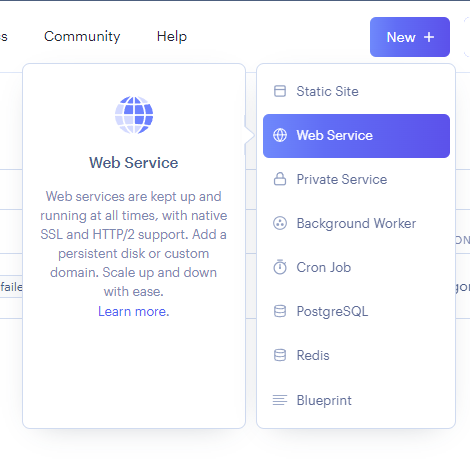
4. Click **New +**
5. Select **Web Service**
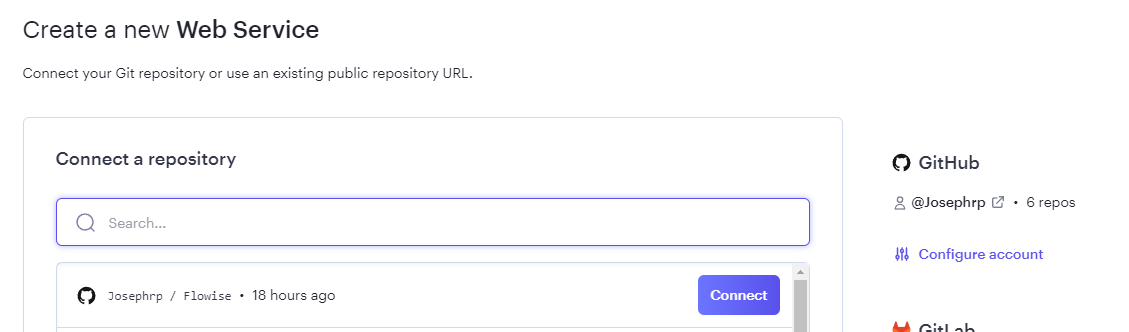
6. Connect Your GitHub Account
7. Select your forked Flowise repo and click **Connect**
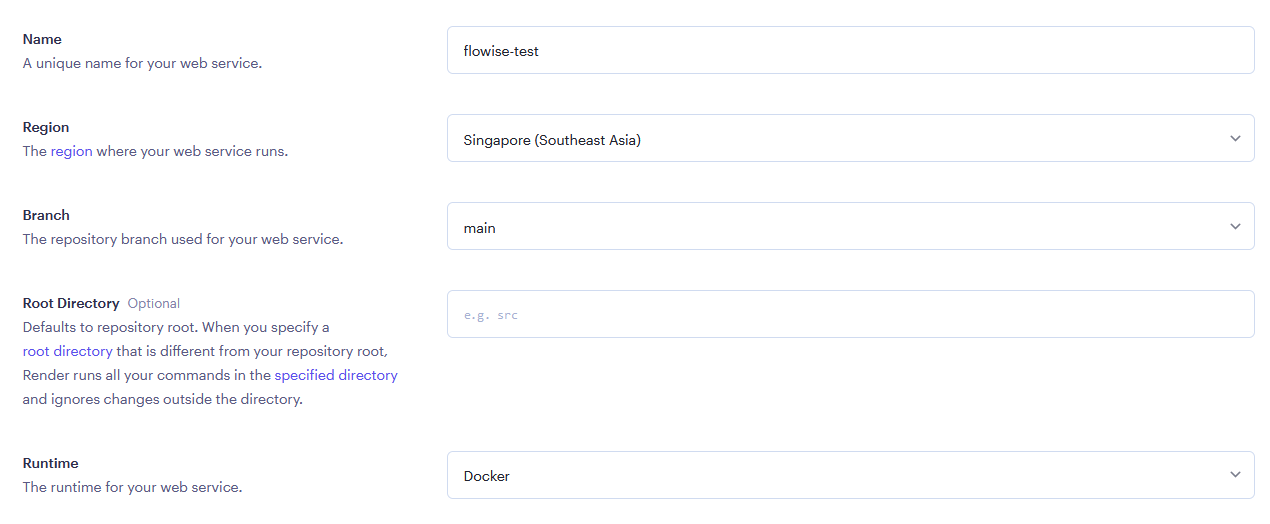
8. Fill in your preferred **Name** and **Region.**
9. Select `Docker` as your **Runtime**
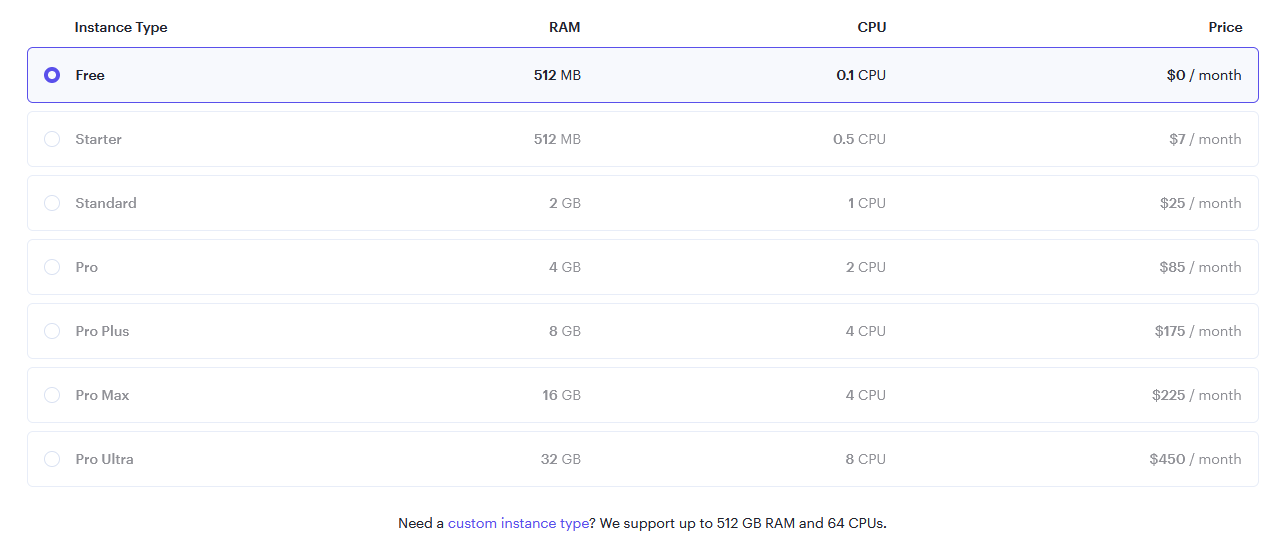
9. Select an **Instance**
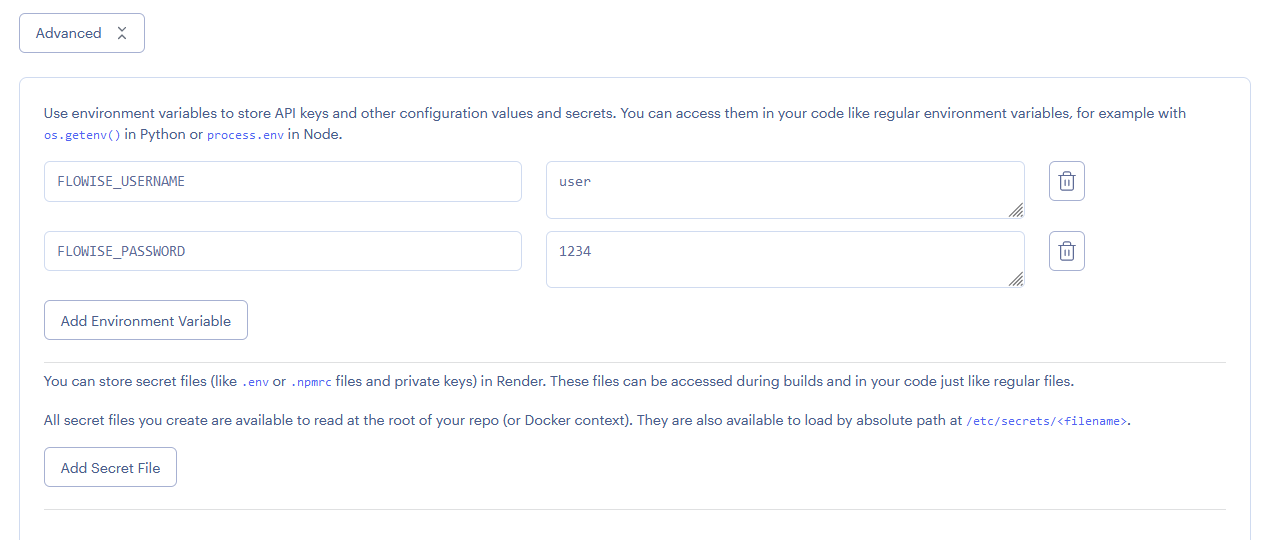
10. *(Optional)* Add app level authorization, click **Advanced** and add `Environment Variable`
* FLOWISE\_USERNAME
* FLOWISE\_PASSWORD
Add `NODE_VERSION` with value `18.18.1` as the node version to run the instance.
There are list of env variables you can configure. Refer to [Environment Variables](/configuration/environment-variables.md)
11. Click **Create Web Service**
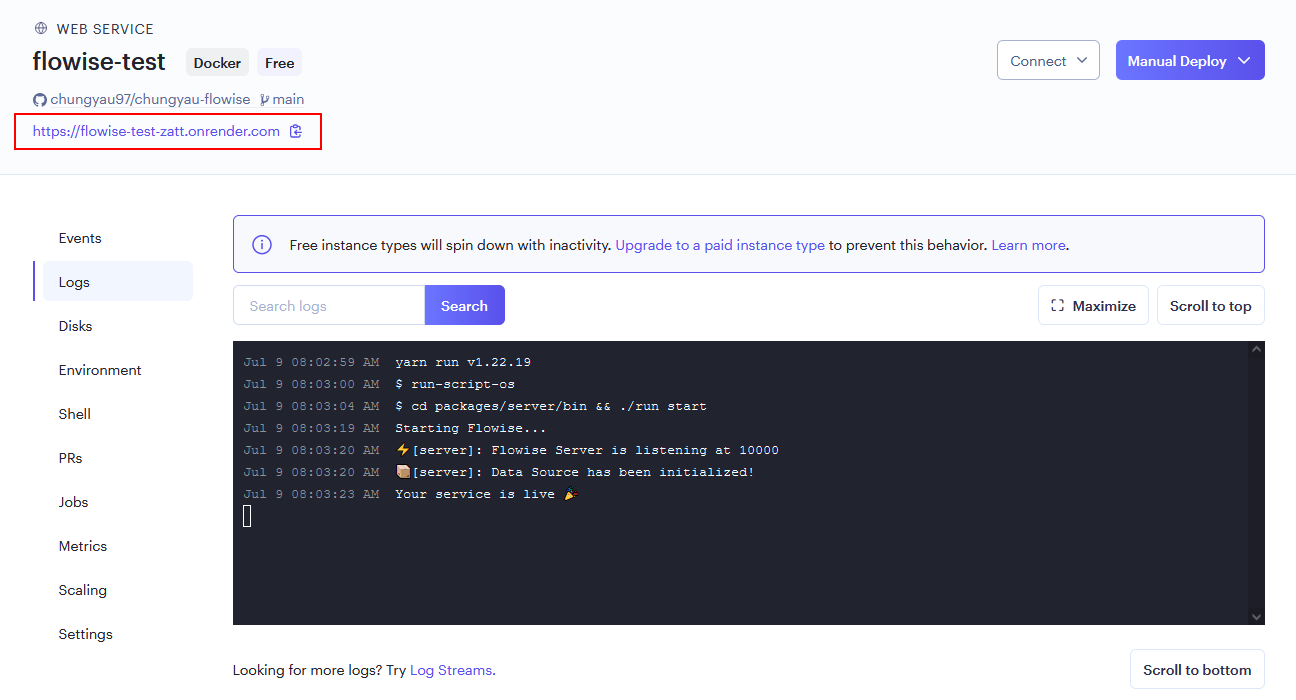
12. Navigate to the deployed URL and that's it [🚀](https://emojipedia.org/rocket/)[🚀](https://emojipedia.org/rocket/)
## Persistent Disk
The default filesystem for services running on Render is ephemeral. Flowise data isn’t persisted across deploys and restarts. To solve this issue, we can use [Render Disk](https://render.com/docs/disks).
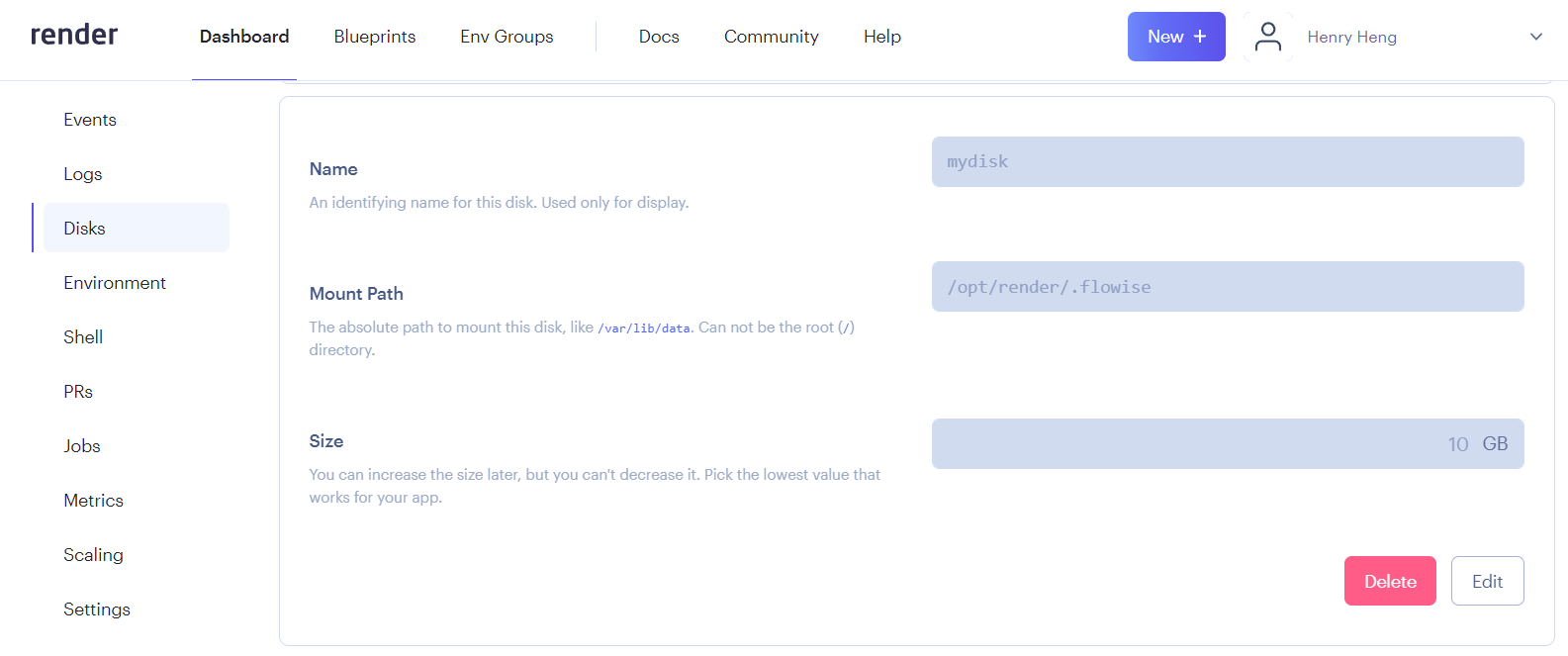
1. On the left hand side bar, click **Disks**
2. Name your disk, and specify the **Mount Path** to `/opt/render/.flowise`
3. Click the **Environment** section, and add these new environment variables:
* HOST - `0.0.0.0`
* DATABASE\_PATH - `/opt/render/.flowise`
* APIKEY\_PATH - `/opt/render/.flowise`
* LOG\_PATH - `/opt/render/.flowise/logs`
* SECRETKEY\_PATH - `/opt/render/.flowise`
* BLOB\_STORAGE\_PATH - `/opt/render/.flowise/storage`
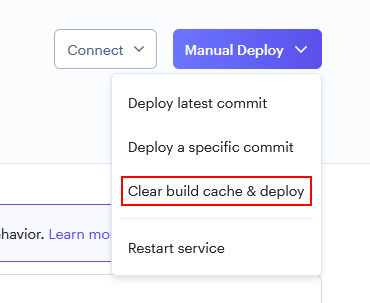
4. Click **Manual Deploy** then select **Clear build cache & deploy**
5. Now try creating a flow and save it in Flowise. Then try restarting service or redeploy, you should still be able to see the flow you have saved previously.
Watch how to deploy to Render
{% embed url="" %}
{% embed url="" %}
---
# Agent Instructions
This documentation is published with GitBook. GitBook is the documentation platform designed so that both humans and AI agents can read, navigate, and reason over technical content effectively. Learn more at gitbook.com.
## Querying This Documentation
If you need additional information that is not directly available in this page, you can query the documentation by asking a question.
Perform an HTTP GET request on the following URL with the `ask` and `goal` query parameters:
```
GET https://docs.flowiseai.com/configuration/deployment/render.md?ask=&goal=
```
`ask` is the immediate question: it should be specific, self-contained, and written in natural language.
`goal` is what the user is ultimately trying to achieve, the reason they need the answer. Sharing it helps GitBook give you a better, more relevant answer. A goal is most helpful when it describes the outcome the user wants rather than restating the question. For example, with `ask=how do I create an API token`, a goal like `automate deployments from our CI pipeline` lets GitBook tailor the answer to that use case.
The response will contain a direct answer to the question and relevant excerpts and sources from the documentation.
Use this mechanism when the answer is not explicitly present in the current page, you need clarification or additional context, or you want to retrieve related documentation sections.


%20(5).png?alt=media)